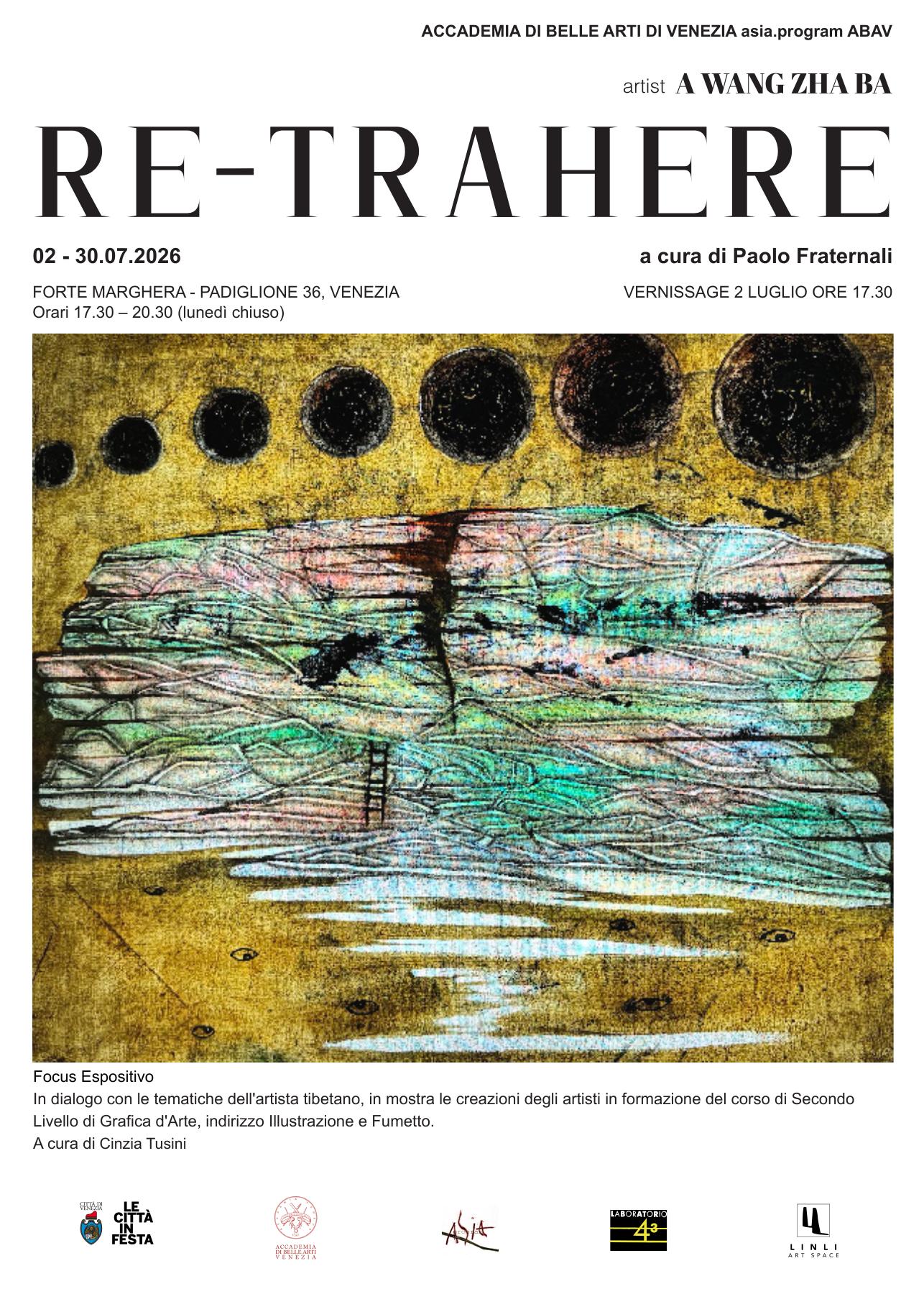
Beyond Identity
English translation of the Italian exhibition text.
The contemplation of a face is already a mystery in itself; with every glance it appears different to us.
Knowing the individual features that compose it is not enough. Perceiving a face requires the viewer to form an overall configuration that changes with the intentions and emotions of the person observed. In making a portrait, the mystery deepens still further, because we expect art to draw from the person something we had been unable to grasp with the naked eye. Yet if we portrayed the same person many times, we would discover that this something changed every time.
For Awangzhaba, the portrait is all of this: a place where mystery is revealed, a mystery that is nothing other than our perception of the other—another human being, but more broadly the world around us. The paintings of Awangzhaba, born in Changdu, Tibet, bring into focus the complexity of an aesthetic question that also conceals ontological and metaphysical questions. The Tibetan artist’s works, exhibited in the Accademia di Belle Arti di Venezia’s exhibition space, Pavilion 36 at Forte Marghera, are an essay of immense depth and sublime elegance that confronts us with the representation of the face in the history of contemporary art, particularly Eastern art.
The Italian term ritratto, or portrait, points to the Latin retrahere: to “draw out” a model’s characteristic elements. But ritratto is also the past participle of ritrarsi, to withdraw: the model itself “withdraws” from the gaze that seeks it. Awangzhaba emphasises this second meaning in an expression that is deliberately ambiguous. All the paintings shown here, under the curatorial direction of Asia.Project ABA Venezia, are elusive images in their intense dynamism: portraits of someone who, unable to expose and clearly reveal themselves in representation because of the ritual power at work, simultaneously withdraws from it. Here, then, the portrait concerns absence—or, more precisely, the “presence of an absence”. The history of this pictorial genre was already bound to the ancient idea of the imago, the image of a deceased ancestor whose presence was magically evoked by the painted face as a sense of belonging to a particular culture.
Portraiture has always pursued a double ambition: to reproduce an almost perfect likeness of the model, and to capture through mimesis the intimate secret of their inner life. If the ambition of classical portraiture—from Paolo Uccello to Giorgione to Picasso—has always been to confront the great question of the subject’s identity, Tibetan artist Awangzhaba interprets it as an identity that continually changes with each new representation, as in Frida Kahlo’s self-portraits. Painting a face thus becomes nothing other than interpreting mystery.
Contemporary art, beyond the great crises of the subject and concerned with so-called “abstraction” or “non-figuration”, nevertheless continues to engage with portraiture, seeking in it the profound meaning of a representation of the unrepresentable. Awangzhaba’s portraits, as in the paintings of the Eyes series, are therefore representations of absence, of a complete withdrawal of the subject, apparently with no inner life to display.
The Eyes series—made using different painting techniques layered on linen and inspired by the philosophical idea that “One generates Two, Two generates Three, Three generates all things”—recalls the childhood experience of living in the forest as night falls. It traces a relationship between the gaze that searches and the infinite retreat of what is sought. It represents and conveys an experience, at once exhilarating and unsettling, of intersecting gazes through which individual inner lives are formed. Yet this formation is denied and deferred into an interminable reflection on childhood memories, marked by a mixture of awe and apprehension.
The series of small and medium-sized paintings made with plant pigments on rice paper, including Ando Chamba, Yongdeng (Geshe) and Dudeng Living Buddha, depicts divine figures through the mimesis of the human body and face. They appear and become known without the attributes of an essential being, bearing an even denser mystery. The series Human Greatness Behind Divinity and Kāma Sūtra Series refer clearly to the idea that human evolution is not merely a physical process but a spiritual journey, in which the Self—the divine essence within us—and the higher bodies evolve through Mystery, culminating in self-awareness and freedom. The human being is thus transformed from a natural creature into a spiritual being capable of reflecting Divinity itself, a process achieved through “cosmic breathing” between physical and spiritual worlds.
A singular inner life, immersed in the totality of nature, is formed and turns into an exposure to the nothingness of the self in the portrait series The Great Realised Ones. It pays homage to Tsangyang Gyatso, of Monpa ethnicity, the sixth Dalai Lama, whose religious name was Lobsang Rinchen Tsangyang Gyatso. He was a poet of popular songs, exceptional talent and refined literary expression. The classic Tibetan woodblock edition from Lhasa, The Love Songs of Tsangyang Gyatso, gathers more than sixty of his poems, now translated into over twenty languages and circulated worldwide as a precious cultural heritage.
In all the series exhibited, Awangzhaba’s painting becomes limpid, vibrates and pulsates. It can be tender and delicate, taking flight and reaching lyrical heights like prayers. Reading the paintings of Awangzhaba—an artist and scenographer in Changdu—is like embarking on an inner journey to rediscover forgotten or dormant aspects of oneself. Awangzhaba is a Master of Art and served as Deputy Secretary-General of the Tibet Artists Association from 1991 to 2018.
Paolo Fraternali
Venice, January 2026